
Custom Data

Your data model, not ours.

Until now Dcycle captured the minimum a report needs. With Elastic Data you create your own categories for anything you track, and add custom fields to the categories that already exist. The richer data your team keeps in spreadsheets can live in Dcycle, next to the data it explains.

Request a demo
Data
CategoriesCustomizeIntegrationsMy filesProcessing
SAP
SAP
Connect SAP Business One, S/4HANA and other ERP modules automatically.
Energy bills
Upload gas, electricity and fuel bills. DESNZ factors applied automatically.
Google Drive
Google Drive
Sync files and spreadsheets directly from Google Drive.
SharePoint
SharePoint
Enterprise collaboration, content management and search.
HubSpot
HubSpot
Import customer and supplier data from your CRM.
Salesforce
Salesforce
Cloud CRM and enterprise computing platform.

Trusted by 2,000+ companies across Europe and North America, from SME to enterprise

ABB
Ajinomoto
Eiffage
KLN
Sabadell
Valeo
One system of record

instead of Dcycle for the report and a spreadsheet for everything else.

Beyond the compliance minimum

Shape the data model to your reality

Create the categories nobody asked you for

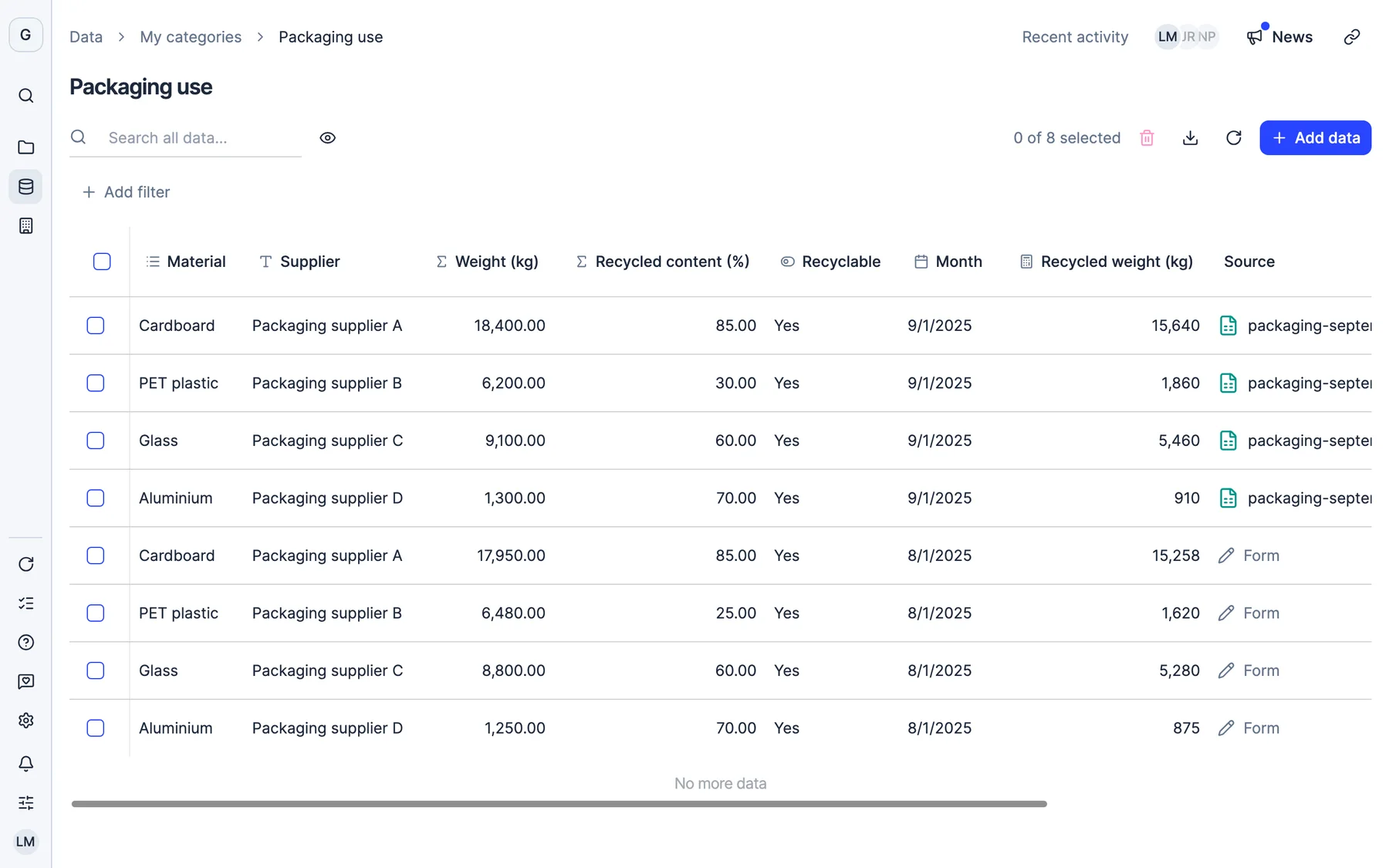
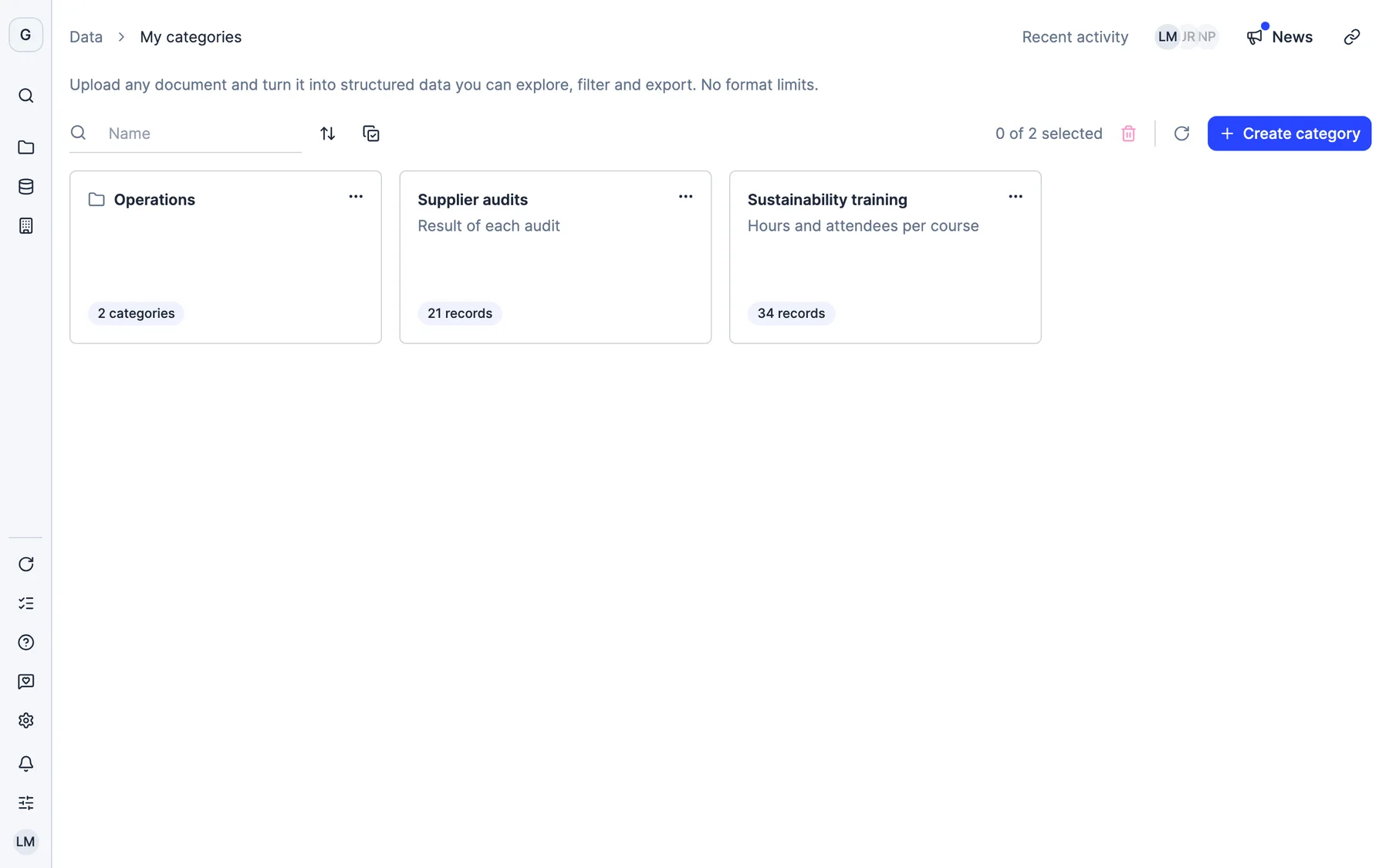
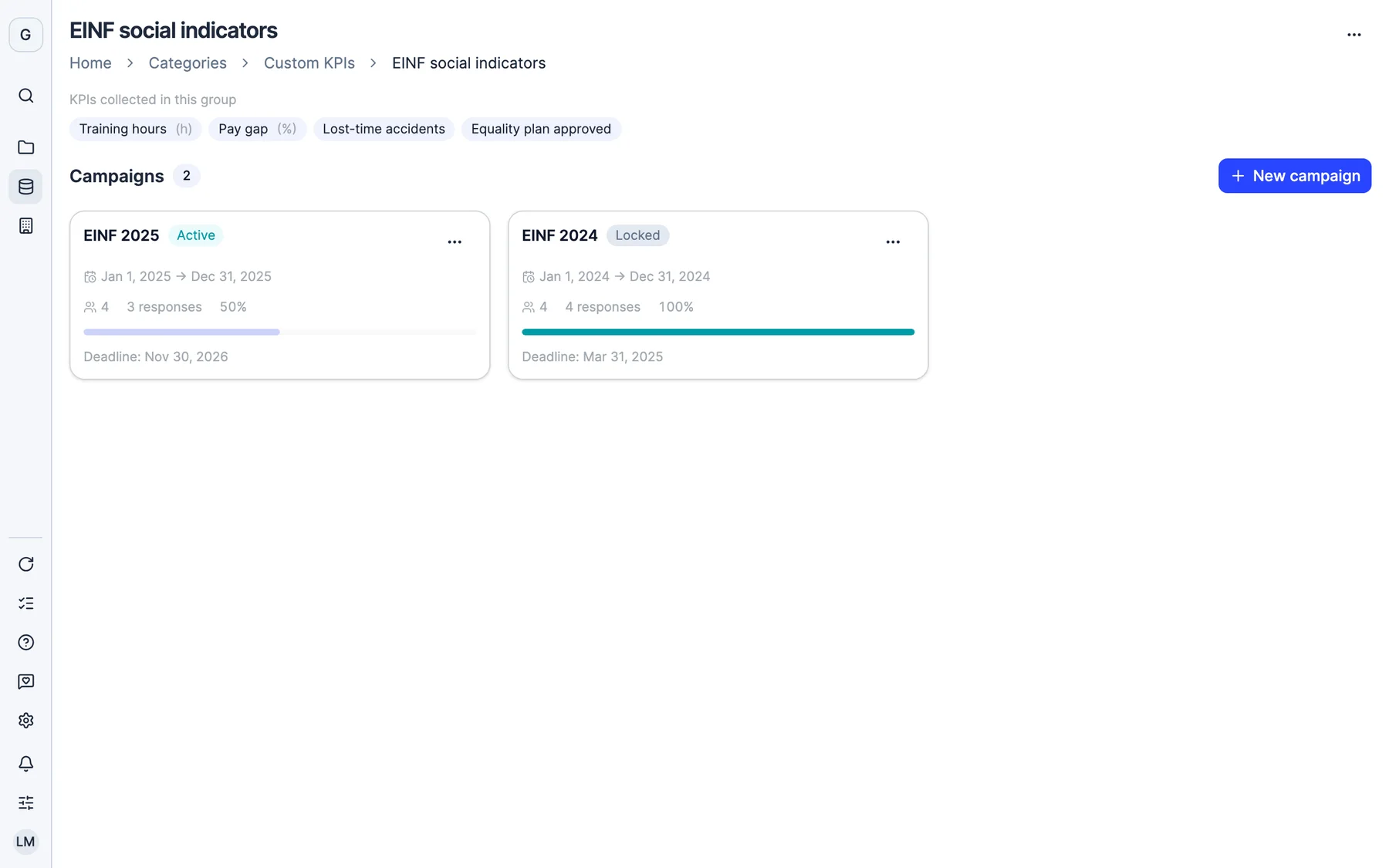
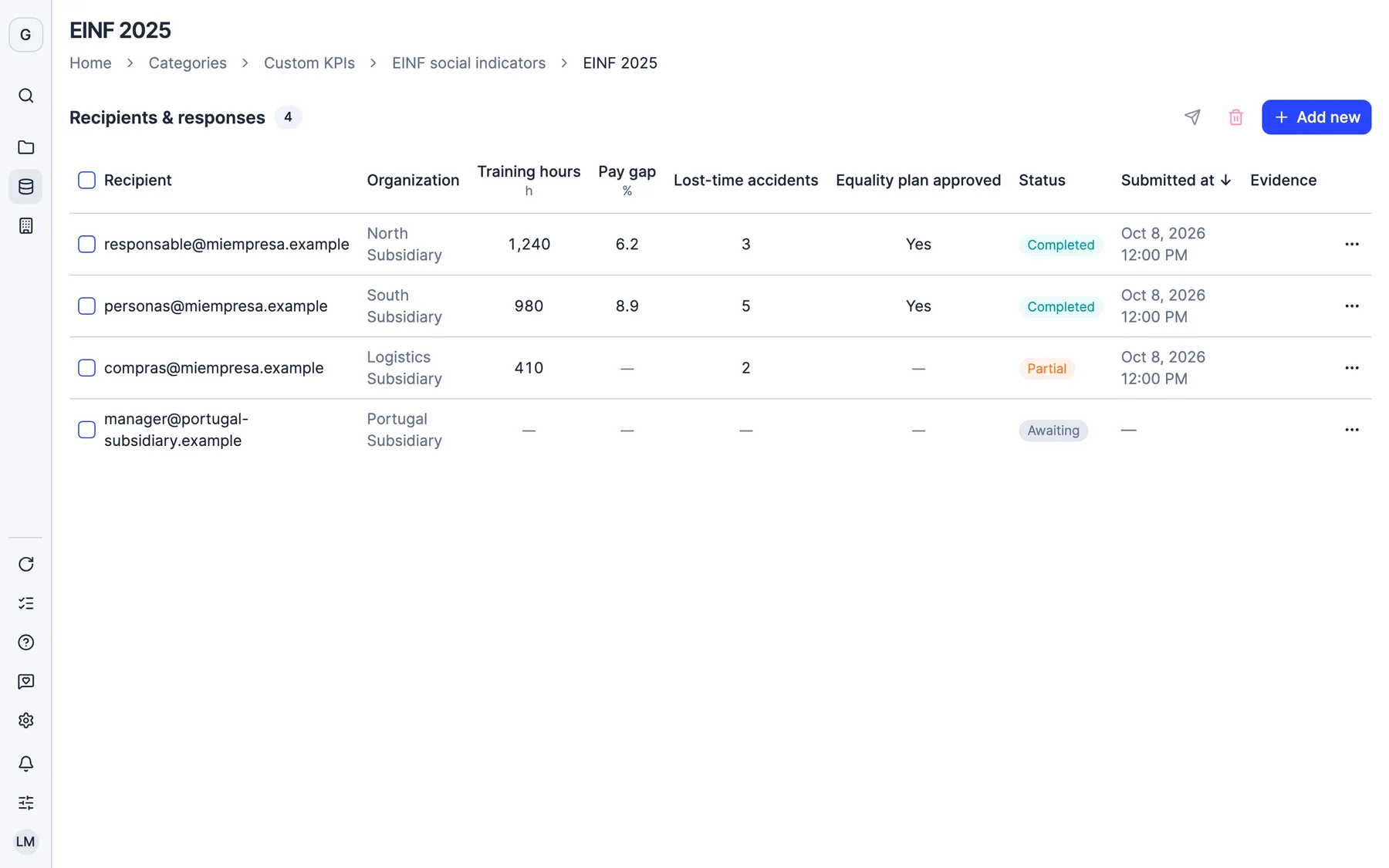
Anything your organisation tracks that Dcycle has no native category for: certifications, training hours, waste streams, packaging formats, plant level KPIs. Create the category, define its fields, and start filling it. No development work, no ticket, no waiting for a release.

Acme Spain — Data
MG
M. García
Data points
1,248
Files
18
8 xlsx
6 pdf
4 csv
Electricity — Q1 2026Madrid HQ · 45,320 kWh · 3 files
Validated
Natural Gas — Q1 2026Barcelona · 8,200 m³ · 2 files
Validated
Business Travel — Q1 2026TravelPerk · 12 trips · 1 file
Review

Extend the categories you already use

Native compliance categories keep their structure and their calculations, and you add the fields you need on top: a cost centre, a contract reference, a production batch, who signed off the invoice. Every custom field stays traceable to the record it belongs to, so the audit trail does not get thinner as the data model grows.

Source TracingElectricity — Q1 2026
CSRD Report→ E1-5 Energy consumption45,320 kWh
CalculationEF: 0.233 kgCO₂/kWh
Grid emission factor · IEA 2025 · Spain
Source documentOriginal
invoice_electricity_q1.pdf · Uploaded by María García · Jan 15, 2026

MCP ready from day one

Custom categories and fields are queryable through the MCP Server exactly like native data, so you can ask Claude about them in plain language and pull them into your own systems. Data you invented last week answers questions the same way your emissions data does.

Claude
Connected to Dcycle
Which are our top 3 emission sources this quarter?
Based on your Q3 data in Dcycle, your top 3 emission sources are:
01Business travel — 38%
02Electricity (Scope 2) — 29%
03Logistics & freight — 18%
Ask about your emissions data...

Master data you define, not a fixed list

Register your own electricity and heat suppliers when they are not on our standard list, record the surface area of each facility for intensity metrics, and build mobility surveys that match your work model with your own questions and conditional logic.

Data collection
SourcesFilesProcessed
Connected sources
SAP
SAP Business One
ERP · 342 rows
Sync
T
TravelPerk
Travel · 89 trips
Sync
Energy bills
Electricity · Auto
Sync
Google Drive
Google Drive
Files · 12 files
Sync
Classified and validated
Electricity · 45,320 kWh
Natural Gas · 12,100 m³
Fleet diesel · 8,400 L
Business travel · 89 trips
Water use · Review
Waste · Pending
Acme Spain — Data
MG
M. García
Data points
1,248
Files
18
8 xlsx
6 pdf
4 csv
Electricity — Q1 2026Madrid HQ · 45,320 kWh · 3 files
Validated
Natural Gas — Q1 2026Barcelona · 8,200 m³ · 2 files
Validated
Business Travel — Q1 2026TravelPerk · 12 trips · 1 file
Review
Source TracingElectricity — Q1 2026
CSRD Report→ E1-5 Energy consumption45,320 kWh
CalculationEF: 0.233 kgCO₂/kWh
Grid emission factor · IEA 2025 · Spain
Source documentOriginal
invoice_electricity_q1.pdf · Uploaded by María García · Jan 15, 2026
Claude
Connected to Dcycle
Which are our top 3 emission sources this quarter?
Based on your Q3 data in Dcycle, your top 3 emission sources are:
01Business travel — 38%
02Electricity (Scope 2) — 29%
03Logistics & freight — 18%
Ask about your emissions data...
Data collection
SourcesFilesProcessed
Connected sources
SAP
SAP Business One
ERP · 342 rows
Sync
T
TravelPerk
Travel · 89 trips
Sync
Energy bills
Electricity · Auto
Sync
Google Drive
Google Drive
Files · 12 files
Sync
Classified and validated
Electricity · 45,320 kWh
Natural Gas · 12,100 m³
Fleet diesel · 8,400 L
Business travel · 89 trips
Water use · Review
Waste · Pending

Additional features

See how Dcycle compares to the alternatives

Your choice Manual process Legacy tools

Custom categories

Create a category for any type of data, define its fields, and it behaves like the rest of Dcycle: uploads, tables, permissions and history.

Custom fields on native data

Add your own fields to compliance categories without touching their calculations. The report keeps working and your context travels with it.

Queryable through MCP

Custom data is exposed the same way native data is, so Claude and your own systems read it with no special integration.

Your own survey questions

Mobility surveys you can edit: choose the work model, add questions, set conditional logic, and send them with automatic translation.

Across the whole group

Custom categories work across the holding and its subsidiaries, with the same roles and permissions as the rest of your data.

Facility level context

Optional fields such as surface area in m2 sit next to each site, ready for intensity metrics when you need them.

“Dcycle helped us consolidate 6 facilities across 2 countries into a single source of truth. Our auditors couldn't believe the level of traceability.”
Lina Pena Corp. Services Director, KLN Iberia
“I see your help as super necessary, I can't imagine maintaining the contract without your advisory component. We went from scattered spreadsheets to a unified system in weeks.”
Yolanda Carazo Environmental Manager, Embutidos Monells
“Our investors value our ESG commitment. Dcycle made us a reference in the financial sector, we can respond to any audit or client request instantly.”
Teresa de Vicente Sustainability Lead, Finsolutia

Data management guides and resources

View all resources

Dictate to Leia with your voice

You can now dictate your questions to Leia: hit the mic, talk, and what you said appears as text in the chat, ready to review and send.

Read more

Frequently asked questions

What is Custom Data?

It is the part of Dcycle that lets you shape the data model to your own reality, shipped as Elastic Data. You can create categories that do not exist in the product, and extend the native compliance categories with fields of your own. The goal is that the data your company actually tracks lives where the reporting data lives, instead of in a parallel spreadsheet.

Can I create a category that Dcycle does not have?

Yes. You define the category and the fields it holds, and from then on it behaves like any other data in the platform: uploads, tables, permissions, history and MCP access. Certifications, training hours, waste streams, packaging formats or a plant level KPI are all typical examples.

Can I add fields to the categories that already exist?

Yes, and this is often the more useful half. Native categories keep their structure and their calculations, and you add the context that matters to you on top: cost centre, contract reference, production batch, internal owner. Nothing about the existing calculation changes.

Does custom data change my emissions calculations?

No. Custom categories and fields store and organise data, they do not alter how Dcycle calculates emissions. Custom electricity and heat suppliers, for example, are informative: they let you record who actually supplies each site, while the emissions still come from the recognised factor databases.

Can I query custom data from Claude or from our own systems?

Yes. Elastic Data is MCP ready from day one, so everything you create is queryable through the MCP Server exactly like native data. You can ask questions in plain language, and your own systems can read it without a bespoke integration.

Who can create categories and fields?

It follows the same roles and permissions as the rest of the platform, so you decide who can change the data model and who can only fill it in. Custom categories work across the holding and its subsidiaries, with the same access control as native data.

Does custom data show up in reports and charts?

Yes. Once it is in Dcycle you can chart it, put it in a table or turn it into a KPI, and take the result into an editable report. That is the point of storing it here rather than in a file: the analysis and the report are one step away.

Does this replace our spreadsheets?

That is the intent. Most sustainability teams run Dcycle for the numbers a framework demands and a spreadsheet for everything else, then spend the year reconciling the two. Custom Data removes the second file, which is also what makes Dcycle usable as a system of record rather than a reporting tool.

Collect once. Use everywhere.

See how Dcycle cuts reporting time by 70%, surfaces operational savings, and gives your auditors what they need, the first time.

See Dcycle in action