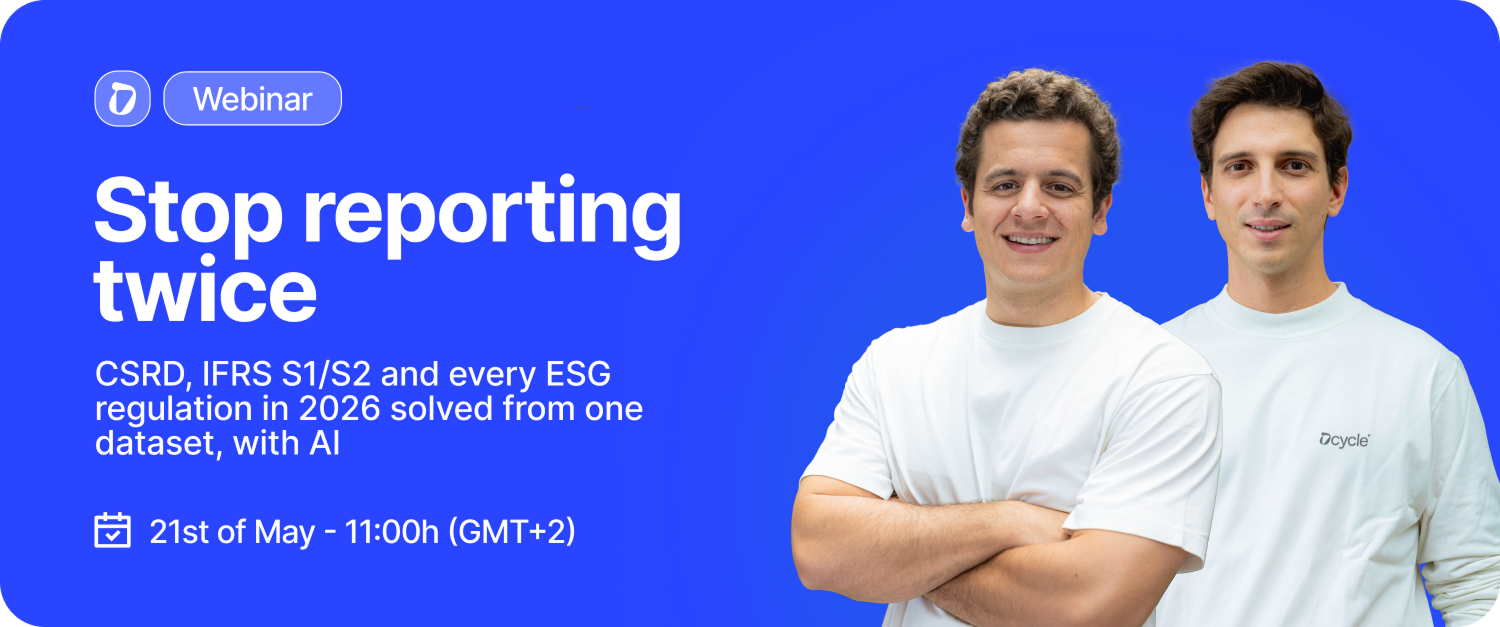
Stop reporting twice: ESG compliance in 2026
CSRD, IFRS S1/S2, CBAM, LkSG: they all run on the same data. Learn to answer all of them from one place.
How to consolidate CSRD, IFRS S1/S2, CBAM and LkSG into one data workflow
4 frameworks. The same underlying data. One session to stop the duplication.
Your sustainability team is juggling CSRD reporting, IFRS S1/S2 disclosures, CBAM declarations and LkSG supply chain due diligence. Each one has its own template, its own deadline and its own owner. The result: the same emissions data, the same supplier information and the same climate risk assessments get collected, structured and reported multiple times.
The problem is not data availability. The problem is that nobody has mapped the overlap.
In this session, Jacobo Umbert and Luis Escamez will show you, with real company data, how to answer all four frameworks from a single structured dataset.
What you will learn
- Where CSRD, IFRS S1/S2, CBAM and LkSG overlap: the shared data layer that powers all four frameworks at once
- How to stop collecting the same data twice: a practical model for structuring ESG data so it answers multiple frameworks simultaneously
- CBAM in practice: what data you need, where it comes from and how to avoid penalties
- LkSG supply chain requirements: how environmental and social data from your suppliers feeds both LkSG and CSRD Scope 3
- Live walkthrough: how Dcycle customers handle multiple frameworks from one platform without duplicating effort
Who is it for
- Sustainability managers working across CSRD, IFRS S1/S2, CBAM or LkSG simultaneously
- Compliance and legal teams mapping overlapping obligations across frameworks
- CFOs and finance directors looking to reduce the operational cost of ESG compliance
- Operations and procurement teams managing supplier data for LkSG and CBAM
- Any company subject to two or more of these frameworks
Agenda
- Regulatory landscape 2026: where CSRD, IFRS S1/S2, CBAM and LkSG stand today and what has changed
- The shared data model: mapping the overlap across all four frameworks
- Eliminating duplicate work: how to structure your data collection once and reuse it everywhere
- Live demo: seeing the unified approach inside Dcycle
- Q&A: open questions with Jacobo and Luis
Register for this webinar
Collect once. Use everywhere.
See how Dcycle can cut your reporting time by 70% and give your auditors what they need , the first time.
See Dcycle in action