Understand how your company and its environment impact each other. Analyze both financial risks and opportunities, as well as environmental and social impacts, to identify what truly matters.
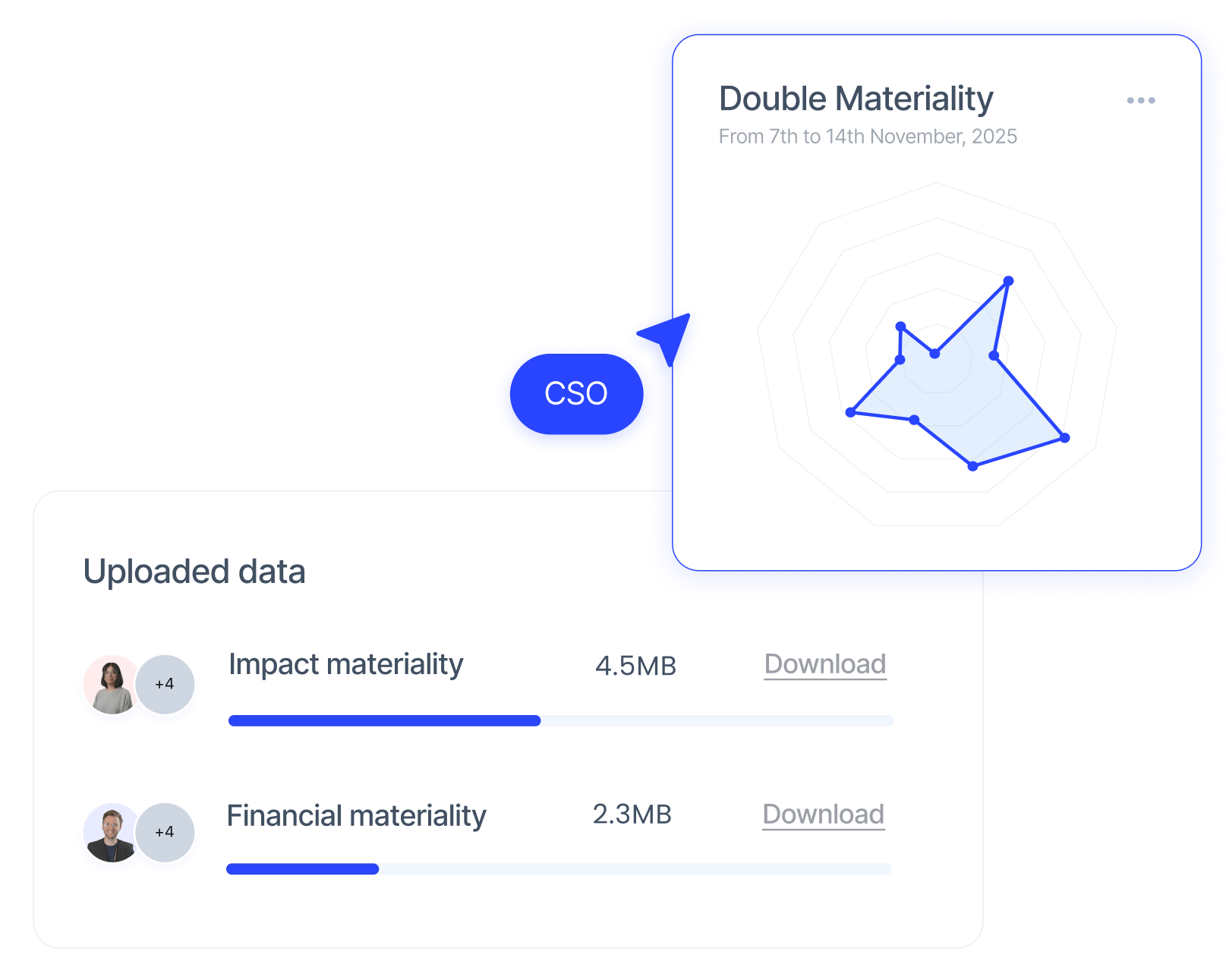
You perform double materiality analysis manually, with frequent errors that increase risk and consume a lot of your time.
High technical complexity
You need to be a sustainability expert to understand how your company and its environment impact each other. A deep technical knowledge of the methodologies is required.
Collaboration challenges
Communication between your teams is limited, making it difficult to collect and analyze non-financial information efficiently.
Lack of strategic visibility
You don’t have a clear view of your company’s sustainability risks and opportunities, which makes it hard to make informed decisions and prioritize actions effectively.
After
What Dcycle improves
Automate data integration
Upload information about your products, services, or processes in any format. Dcycle takes care of standardizing it.
Reuse your ESG data
Leverage what you already have. If your data has already been used for LCA or carbon footprint calculations, you don’t need to upload it again. Reuse it and eliminate the feeling of starting over.
360º analysis in minutes
Automatically analyze impact materiality and financial materiality, considering how your company affects the environment and how external factors impact your business.
Stay one step ahead
Gain a complete view of your sustainability risks and opportunities. Prioritize actions and demonstrate your commitment to clients, partners, and stakeholders.
"Beyond what we’ve achieved, Dcycle has become our main source of sustainability knowledge. Everything we’ve learned since partnering with Dcycle has been incredibly valuable. For instance, we fully understood the transition to GLEC 3.0 thanks to them. Dcycle doesn’t just provide us with a tool — they offer continuous learning that keeps us aligned with the Sustainable Development Goals"